
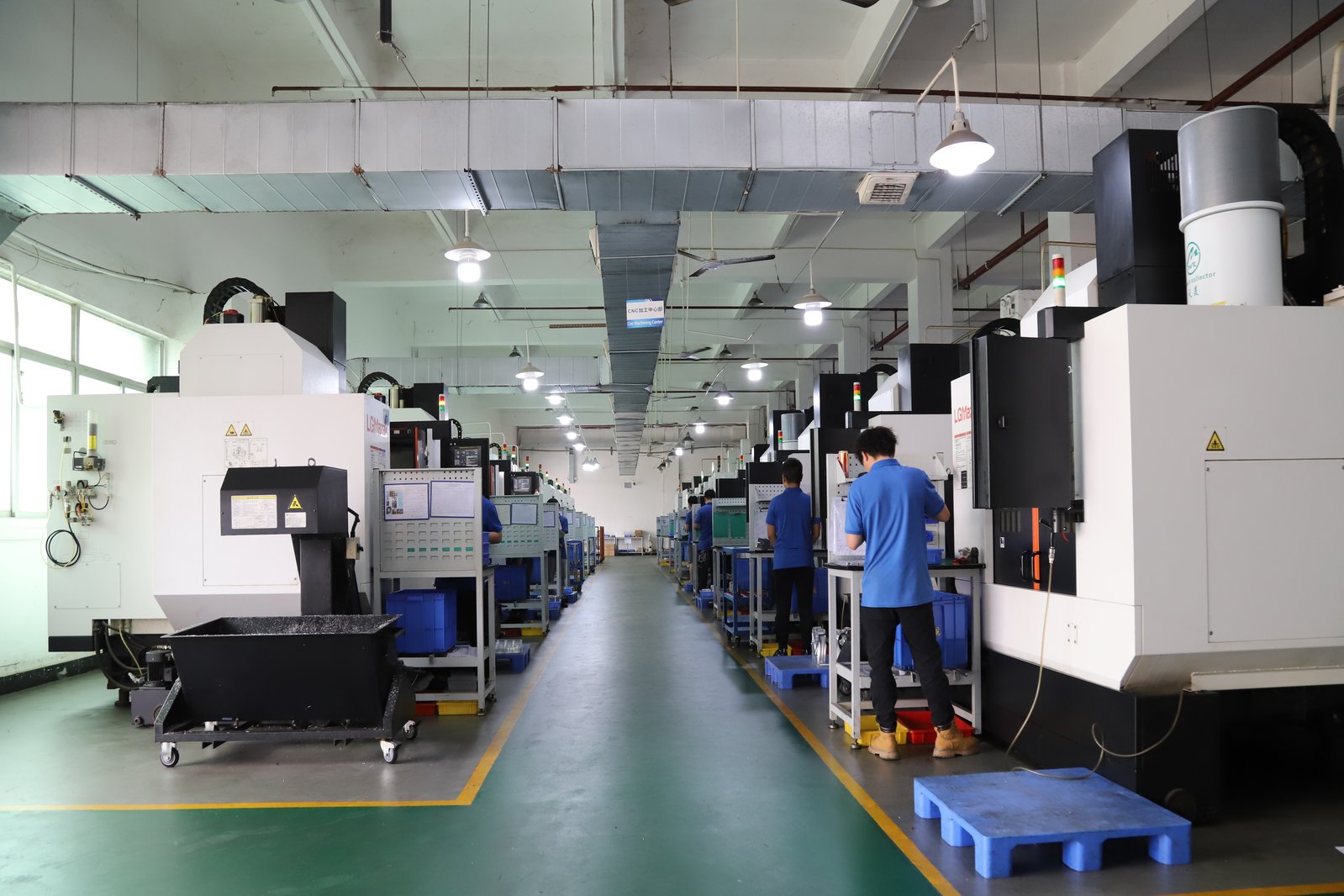
Almost every machined-part material decision lands on the same question: aluminum or stainless steel. Both machine well on CNC lathes and mills, both hold tight tolerances, and both finish cleanly, yet they serve opposite ends of the design spectrum. Aluminum is light, thermally conductive, and fast to cut; stainless is dense, stiff, and corrosion-resistant. The choice between them is usually settled by four questions about the part's service life — corrosion, load, weight, and temperature — and then refined by the machining economics that follow, which differ between the lathe and the mill. This guide walks a buyer through both halves of the decision, with the alloys that matter inside each family and how CNC turning and milling treat them differently.
Which questions should decide the material before the quote?
Material selection belongs at the front of the design, not at the quote stage, and four service questions settle most of it:
- Will the part face corrosion, chemicals, or bodily contact? Stainless exists for environments where aluminum will pit or corrode — salt water, process chemicals, food contact, medical and surgical use. Aluminum survives dry indoor service well, but its corrosion resistance is a surface property, and once a scratch or a cut edge exposes the base metal it depends on its anodize or coating for protection.
- What is the load and stiffness requirement? Steel is roughly three times as stiff as aluminum and can carry far higher loads in the same section. If deflection under load is the failure mode, stainless wins in a smaller envelope. If the part must be light, aluminum wins at equal or better strength per unit of weight.
- What does the part weigh, and does weight matter? Stainless weighs about three times what an aluminum part of the same volume weighs. On shafts, fittings, housings, and moving assemblies that difference is real and immediate; on static mounts it may be irrelevant.
- What temperatures and finishes will the part see? Aluminum loses strength above roughly 150 °C and cannot take hard service heat; stainless holds its properties far higher and resists oxidation. Anodized aluminum suits cosmetic and moderate-wear surfaces; stainless suits autoclave, washdown, and abrasive service.
If the service environment leaves the choice open, the tie-breakers are weight, thermal conductivity, and price, and all three favor aluminum. When both materials could plausibly work, the engineering-standard move is to prototype in the production material and confirm the choice against real service conditions before committing volume.
How do the two families compare on the properties that drive the choice?
The mechanical comparison below uses typical values for the common grades; the exact numbers depend on the temper and condition, so the drawing should always name the grade and state together.
| Property | Aluminum 6061-T6 / 7075-T6 | Stainless 303 / 304 / 316 | What it means for the part |
|---|---|---|---|
| Density | ≈ 2.7 g/cm³ | ≈ 7.9–8.0 g/cm³ | A stainless part weighs roughly three times its aluminum equivalent |
| Stiffness (elastic modulus) | ≈ 69 GPa | ≈ 190–200 GPa | Steel deflects far less under the same load and section |
| Typical yield strength | ≈ 276 MPa (6061-T6); ≈ 503 MPa (7075-T6) | ≈ 215–515 MPa depending on grade and condition; 17-4PH H900 over 1100 MPa | Steel wins absolute strength; aluminum wins strength per unit of weight |
| Corrosion resistance | Good with anodize; relies on surface protection | Inherent — stainless is the alloy for corrosive service | Environment decides; stainless when corrosion or hygiene dominates |
| Thermal conductivity | High | Low | Aluminum conducts heat and dissipates cutting heat; stainless holds it |
| Machinability | Excellent | Good but work-hardening | Aluminum cuts faster with less tool wear on both lathe and mill |
Two notes make the table usable. First, "stronger" without a unit of comparison is meaningless — 7075-T6 aluminum is stronger than annealed 304 stainless in yield terms, yet steel is stiffer and heavier. Decide whether the design is limited by stress, deflection, weight, or corrosion, and the table points one way. Second, strength figures describe the alloy condition, so an aluminum part specified without its temper or a stainless part without its condition leaves the shop guessing at properties the drawing never defined.
Which aluminum alloys should a buyer actually specify?
Aluminum for machined parts concentrates on two workhorse grades. 6061-T6 is the default: it machines cleanly on lathe and mill, holds tolerances and fine finishes well, anodizes evenly, and is inexpensive as raw stock. It carries enough strength for housings, brackets, fittings, and instrument bodies, and it is the grade most shops will quote unless told otherwise. 7075-T6 roughly doubles the yield strength for weight-critical or highly loaded parts — aerospace brackets, high-stress frames — at a higher raw material cost and with slightly less predictable anodize response, so it is specified when the application needs it, not by habit.
Beyond those two, buyers occasionally need other tempers for specific corrosion or formability reasons. For CNC machining, the aluminum choice rarely changes the machining strategy; it changes the raw stock cost and, for 7075, the fixturing care needed on thin sections, because the higher strength comes with slightly lower elongation and a greater tendency to spring under residual stress when material is removed unevenly. On a turned part, the bar diameter and its straightness matter as much as the grade; on a milled part, the plate or billet form and its stress state decide whether thin features hold still. If the shop machines near-net from thick stock, stress relief of the raw material before cutting is worth asking about.
Which stainless grades matter, and how do they differ?
Stainless is a family, not a material, and the grade choice drives both the part's properties and its machining economics. 303 is the free-machining grade — a sulfur addition makes it cut fast and clean, at the cost of slightly lower corrosion resistance — which makes it the economical choice for non-critical hardware and instrument parts, and it is a favorite for turned work precisely because it cuts so freely. 304 is the general-purpose grade, with better corrosion resistance and good toughness, but harder on tooling than 303. 316 and 316L add molybdenum for pitting and chloride resistance — the default for marine, chemical, and implantable-adjacent work, with 316L's low carbon content resisting sensitization in welded or heated parts. 17-4PH is the precipitation-hardening workhorse when the part needs high strength and hardness after machining — hardened to over 1100 MPa yield in the H900 condition, it machines in the softer annealed state and is heat-treated afterward.
For a buyer the practical map is simple. If the environment is mild and the part is hardware, 303 or 304 keeps the quote down. If corrosion resistance is the point of using stainless at all, 316/316L is the safe default and 304 the economy version. If the part must carry load or resist wear, 17-4PH with post-machining heat treatment is the option, and the heat treatment belongs on the RFQ, because it adds an operation, a vendor leg, and a schedule. Naming the grade without the condition, on 17-4PH especially, is how a buyer ends up with a part that never reaches its specified strength.
How do aluminum and stainless behave differently on the lathe and the mill?
The machining gap between the families shows up in three places a CNC shop feels directly: cutting speed, heat, and rigidity. Aluminum cuts at high spindle speeds and feeds with excellent tool life, and because it conducts heat away from the cutting edge, long turning passes and deep milling pockets stay cool. Stainless is the opposite — it holds heat in the cutting zone, work-hardens if the tool dwells or rubs, and demands sharp inserts, consistent feed, and flood coolant. On the lathe, stainless turns stringy or gummy chips that need chip control; on the mill, it punishes any deflection with chatter that ruins finish and tools. The result is that a stainless part runs slower, wears more tooling, and costs more per minute on the machine, before a single material dollar is counted.
Rigidity is where the geometry meets the material. Aluminum's low modulus means thin walls and long unsupported features deflect more easily and need conservative cuts or support; stainless's stiffness resists deflection but punishes any flex in the setup. Thin-walled stainless parts are among the hardest machining jobs in either process family because the material refuses to cut fast while the wall refuses to hold still. If your part combines thin walls with a stainless requirement, the design review should flag it early, because the machining strategy, the quote, and the schedule all change. The parts guide covers the geometry side of the material decision.
How does the material choice change tolerance, finish, and coating?
Tolerance is the one area where the two materials should not behave differently. A critical dimension on an aluminum part and one on a stainless part are held to the same standard — ±0.003 mm in turning and milling, verified on inspection equipment with capability at Cpk 1.67 or higher on key characteristics and Cpk ≥ 1.33 on general characteristics. Capability is reported per characteristic: every report names the feature, its tolerance band, the sample size, the sigma method, and the study window and ±0.002 mm by grinding where a journal or sealing surface needs it. The practical difference is thermal: aluminum expands more with heat and is softer under clamping pressure, so a thin aluminum section machined without coolant control can move between roughing and finishing passes, while stainless holds its shape and gives it to the tool instead. Neither material excuses a sloppy tolerance block; both reward critical callouts reserved for the features that control function.
Surface finish and coating are where the families diverge cleanly. Aluminum finishes well straight off the tool and takes anodizing — standard anodize for corrosion and appearance, hardcoat anodize for wear resistance, with dye colors available for identification. Stainless is passivated after machining to remove embedded free iron and restore corrosion resistance; it does not take an anodize-type coating. When the design brief calls for a colored or wear-resistant surface, that is an aluminum conversation; when it calls for autoclave-safe, hygienic, or chemically inert surfaces, it is a stainless conversation. The treatment choice therefore tends to reinforce the material choice, and both belong on the RFQ so the quote, the schedule, and the finish record include them. The services overview explains how machining and finishing combine into one order.
What does each choice cost in machining terms?
In machining terms the gap is large and one-directional. Aluminum is the economical default: inexpensive bar and plate stock, fast cutting, long tool life, and short cycle times. Stainless costs more at every step — bar stock at a higher price per kilogram, slower cutting that extends every operation, shorter tool life that adds consumable cost, and more inspection care on tight features. A stainless part typically quotes at a multiple of its aluminum equivalent for the same geometry, and the multiple grows with part size and feature count. Add the offshore shipping leg and the landed cost amplifies the difference, which is why the material decision should be made on function, not on a first glance at the price.
That premium is a decision input, not a verdict. When the service environment demands stainless — corrosive washdown, chemical contact, hygienic food or medical surfaces, high loads in small sections — the premium is the price of the part working at all, and aluminum is not an alternative. When the environment does not demand it, the premium buys nothing, and aluminum is the engineering-sensible default. The buyers who pay most for the wrong material are the ones who defaulted to stainless out of caution on dry indoor parts, or who chose aluminum for a part that spends its life in a corrosive wash — both errors are visible in the first service question, before a quote exists.
How do you validate the material choice before production?
The cheap way to validate a material decision is a prototype in the production grade, machined on the same process and tolerance the volume order will use. A single aluminum part tells you geometry, fit, and finish questions; it tells you nothing about how stainless will cut, hold tolerance, or finish on thin sections. If the production material is stainless, the prototype should be stainless — the machining behavior, the fixturing, and the inspection plan all depend on it. The extra prototype cost is small against the cost of discovering a machining problem after the production program is written.
For an order from a CNC turning and milling supplier, the validation also confirms the material record: the prototype should arrive with its mill certificate and dimensional report, so the production grade is proven before volume moves. Confirm the treatment early — an anodize class or a passivation requirement has its own vendor, its own schedule, and its own acceptance criteria, and adding it after the quote moves both the price and the date. The quality page shows how material verification and measurement back both families, and the contact page is where a specific part gets a specific recommendation on grade, condition, and treatment.
Frequently Asked Questions
Should my CNC turned or milled part be aluminum or stainless steel?
Start with the service environment. Corrosion, temperature, and contact with food, chemicals, or the human body push toward stainless; weight, thermal conductivity, cost, and machinability push toward aluminum. When both could work, prototype in the production material and confirm against real service conditions.
Which is stronger, aluminum or stainless steel?
In absolute terms stainless is stronger and roughly three times stiffer — steel is about three times the density of aluminum with a much higher elastic modulus. Per unit of weight the picture reverses, which is why aluminum wins weight-sensitive designs. Compare yield strength and stiffness against the actual loads.
Why is aluminum easier to machine than stainless?
Aluminum cuts fast on both lathe and mill, conducts heat out of the cutting zone, and holds fine finishes readily. Stainless retains heat at the tool edge, work-hardens if the tool dwells, and needs rigid setups and consistent feed. That gap shows up in cycle time, tool life, and the cost of thin-walled or deep-pocket geometry.
Which alloy should I choose within each family?
For aluminum, 6061-T6 is the default and 7075-T6 the high-strength option. For stainless, 303 machines most freely, 304 is the general-purpose grade, 316/316L adds corrosion resistance, and 17-4PH is the precipitation-hardening choice for high strength. Name the grade and condition on the drawing.
Can aluminum be anodized and stainless passivated?
Yes. Anodizing builds a hard, corrosion-resistant oxide on aluminum and accepts dyes; hardcoat anodize suits wear surfaces. Passivation removes embedded free iron from machined stainless and restores corrosion resistance. Specify the treatment class on the drawing so the quote and the finish record include it.
Do the two materials hold the same machining tolerances?
Critical dimensions on both are held to the same standard — ±0.003 mm in turning and milling, with capability at Cpk 1.67 or higher on key features and Cpk ≥ 1.33 on general characteristics. Capability is reported per characteristic: every report names the feature, its tolerance band, the sample size, the sigma method, and the study window and ±0.002 mm by grinding where a journal or sealing surface needs it. The practical difference is thermal: aluminum moves more with heat and deflects more under clamping.
Is stainless always more expensive to machine?
Almost always. Bar stock costs more, cutting runs slower, and tool wear is higher, so a stainless part typically quotes at a multiple of its aluminum equivalent. The premium is justified when corrosion resistance, strength, or the application demands it — otherwise aluminum is the economical default.
Unsure whether your turned or milled part should be aluminum or stainless?
Send the model and service conditions to [email protected] or call +86 13126536955, and the recommendation will name the grade, the condition, and the machining trade-offs.