
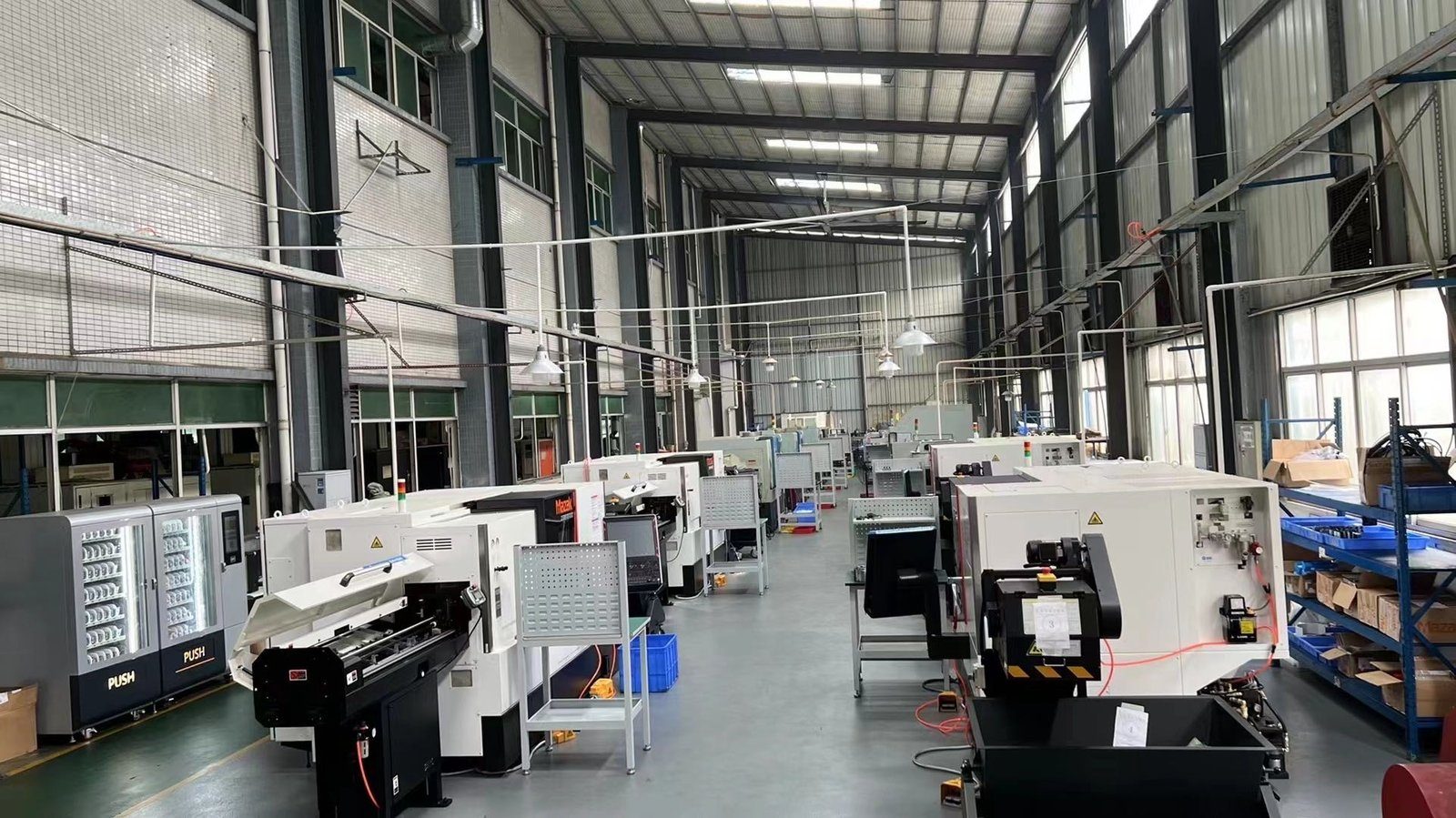
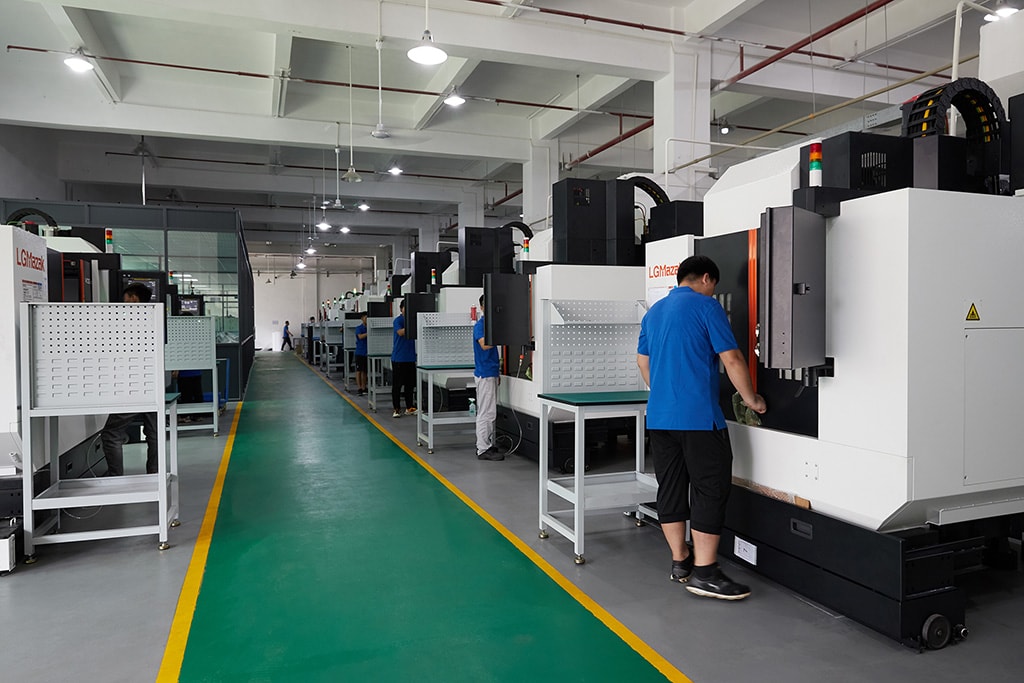
- 6,800 m² facility in Hengli Town, Dongguan — founded 2005, 100+ people.
- 100+ production machines — flexible capacity across any batch size.
- MOQ 1 piece — low and high volume on the same floor.
- Registration No. 91441900MA4UWT6X39 — legal name Dongguan Zhuohang Ltd
Where is the factory, and why does location matter for economics?
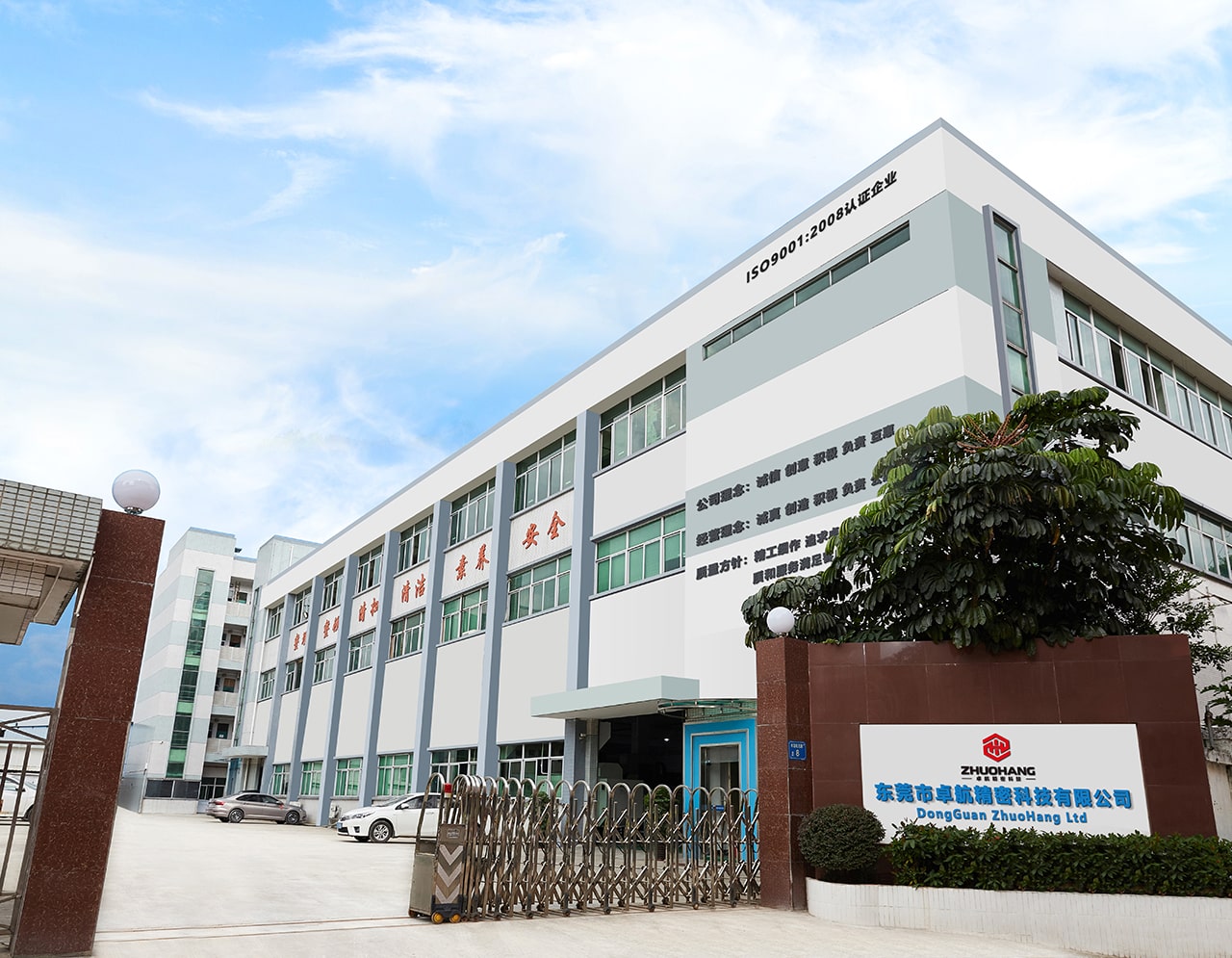
The facility sits at No. 8, Shuibian Songyuan Road, Hengli Town, Dongguan, Guangdong, China 523470 — in a dense machining supply region. Location matters for economics because it shortens the supply side: raw material and secondary processes are close. A low-volume job is not burdened by long freight and a high-volume job is not bottlenecked by material lead time.
Why density matters to your quote: when material suppliers, heat treaters, and platers sit minutes from the floor, a multi-process part does not spend its cost budget on trucks and customs between operations. That short loop is what keeps a complex part's economics on the curve you were quoted, rather than inflated by a supply chain that crosses two borders before the part is even finished.
How to judge it: ask where the secondary operations happen. A shop that farms plating or heat treatment across a border has added freight, lead time, and a hand-off you are paying for; a shop whose secondaries are local has kept the process tight and the cost honest.
Can the factory serve both a prototype and a production run?
Yes, on the same floor and the same quality system. The MOQ is 1 piece, and there is no separate prototype line with looser discipline — the single part you validate is produced under the same control as the thousand parts you later order. That continuity is what makes the economics scale cleanly: you do not re-qualify between a prototype and a production run, because they were never on different systems.
What that continuity is worth, in money terms, is the re-qualification you do not pay. When a shop runs a separate prototype cell, the production line has to be brought up to the same standard on its own — new first articles, new inspection, new lead time, all billed or absorbed somewhere. When the two share a floor and a work instruction, the pilot's evidence carries straight into production, and the scale-up cost is near zero.
your test is one question: will the work order that made my first article also make my production run? If the answer hedges, the continuity you were promised is thinner than it looked.
How does the machine count shape the unit-cost curve?
Machine count is what gives a factory the flexibility to serve the whole cost curve. With 100+ production machines, a job slots in at any batch size without displacing others, and a breakdown does not idle your part.
| Area | Count | Batch flexibility |
|---|---|---|
| CNC milling (3/4/5-axis) | 50+ / 20+ / 20+ | Single parts and long runs |
| CNC turning | 25+ lathes | Round parts from one to many |
| Precision grinding | 7+ grinders | Finish operations at scale |
| Inspection instruments | 20+ | Verification at any volume |
Why the count itself is an economic signal: a shop with 100+ production machines can absorb your job at any batch size without bumping someone else's, which means your prototype does not queue behind a production run and your production run does not crowd out a prototype. That scheduling slack is invisible on the quote and very visible on the delivery date.
The second-order effect is redundancy. When one machine fails, a deep floor re-routes the job to a sister machine and the batch keeps moving; a thin floor stalls, and the stall shows up as your late shipment. Capacity, in other words, is not just throughput — it is the buffer that protects your schedule and, with it, the real cost of your order.
How many machines and people run the facility?
The facility runs 100+ production machines — milling, turning, mill-turn, and grinding — plus 20+ inspection instruments, staffed by 100+ people with 80%+ skilled technicians and 60% holding 5–10 years on the job. Workforce depth matters for economics because a senior workforce holds the process in control longer, producing fewer rejects, and rejects are the cost that erodes a volume discount.
Why the people count shows up in your unit price: a senior operator catches drift at the machine, before it becomes a rejected batch; a junior one catches it at inspection, after the parts are already scrap. The difference between the two is the rework line on your invoice. A floor with a deep bench of experienced people is buying you consistency, and consistency is what keeps a volume price from leaking into rework.
your question is not just how many people, but how long the ones touching your part have been at it. Tenure is the cheap way to read whether the process will hold through a long run or drift as soon as the shift changes.
What certifications does the factory hold?
Certification matters for economics because a controlled process produces predictable output at predictable cost.
| Standard | Certificate number | Scope |
|---|---|---|
| ISO 9001:2015 | 116024/A/0001/UK/En | Machining of metal parts |
| IATF 16949:2016 | 131941/A/0001/SM/En | Manufacture of CNC metal machining parts (excludes product design, Clause 8.3) |
| ISO 14001:2015 | 116024/B/0001/UK/En | Environmental management related to machining of metal parts |
Honest scope note: IATF 16949 excludes product design under Clause 8.3 — this is a build-to-print factory, which keeps the economics unambiguous about who owns design responsibility.
Why certification matters to a buyer who only sees a price: a certified system is an audit trail that says the process is controlled, and a controlled process produces predictable output at predictable cost. Without it, the same unit price on paper can mean a very different one in practice, once the rejects and rework land on your dock. The certificate is the guarantee that the discount you negotiated is not being quietly spent on scrap.
How does the factory keep a quality hold from eroding your discount?
A quality hold is an economic event, and the factory's job is to keep it small. Batch-level traceability quarantines only the affected lot while the rest of the run keeps its value, and parallel inspection capacity means verification does not stall shipment. At production volume, that isolation is the difference between scrapping a small lot and scrapping the order that carried your discount.
What "keeping it small" looks like in practice: the moment a non-conformance is found, the lot is quarantined and the rest of the run keeps shipping on its schedule. The alternative — shutting the whole run down while the problem is investigated — is where a small defect becomes a program-wide delay, and the delay becomes the real cost of the batch.
your question is whether traceability runs at the batch level or the order level. Batch-level means a problem is contained; order-level means a problem is amplified, and you will see the difference in your delivery date and your rework bill.
Can you verify the factory before committing to a volume?
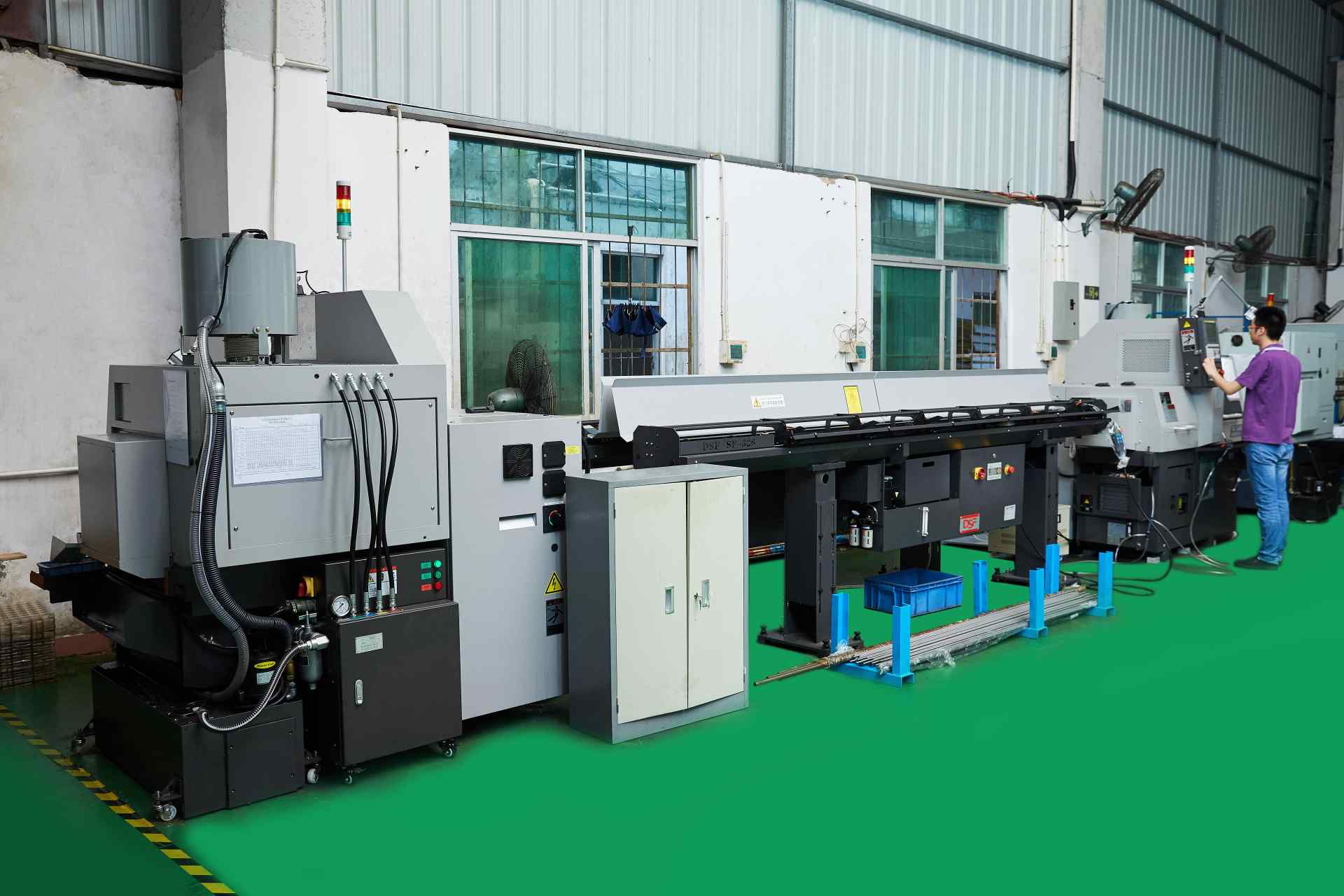
Yes, and you should — a unit price is only as real as the floor behind it. A factory visit is welcome, and a live video walk is available for buyers who cannot travel. The purpose is to verify the machines and the capacity that back your price, because a low quote from a thin floor is not an economy; it is a risk you will pay for later.
What to verify, in order: first, that the machine brands and counts claimed on the quote are actually on the floor; second, that inspection runs alongside production, not as an afterthought; third, that the floor has the slack to absorb your batch at your schedule. Each of these maps to a cost you would otherwise discover after the order is placed.
- Ask for a live walk, not a curated photo set — the real floor tells you more than the brochure.
- Look for your part's process — lathes for round work, mills for prismatic, grinders for finish.
- Check the schedule board — a floor at capacity is a delivery risk in disguise.
How does capacity planning differ between a pilot and a production run?
A pilot run carries setup and first-article time; a production run carries only run time, because the setup is already proven. That is why reorders ship on a shorter clock and at a lower amortized cost. The buyer who front-loads the pilot early in the program buys a fast, cheap reorder lead time for the life of the part — the economics of scaling, executed deliberately.
Why does a deep machine bench lower your real cost?
A deep bench lowers your cost in a way that never appears on the quote: it absorbs variance. Tool wear, a broken insert, a machine that needs service — each of these is a small event on a deep floor and a schedule-breaking event on a thin one. The buffer is what keeps your batch moving while the problem is fixed, instead of waiting while the whole line waits.
How does a factory's location reach your freight line?
Location is a freight line on your total-cost bill, and it works in two directions. Close to a port, the finished part ships cheap and fast; close to the material supply, the raw bar arrives cheap and fast. Dongguan's machining cluster offers both, which is why a part made here can carry a lower landed cost than the same part made somewhere with a cheaper headline price but a longer, pricier tail.
your discipline is to compare landed cost, not factory price. A quote that looks cheap before freight and customs can look expensive after; a quote that accounts for the supply chain is the one that reflects the number you will actually pay.
What should a buyer confirm before committing volume?
Before you release volume, confirm the four things that decide whether the unit price you were shown is the unit price you will get:
- The machines exist — seen on a live walk, not just listed on the quote.
- The process is proven — the pilot's SPC and CMM evidence, not a promise.
- The quality system holds — certification and traceability, not a slogan.
- The capacity has slack — a schedule with room for your run, not a floor already at its limit.
Each of these is cheap to verify before the order and expensive to discover after it. The volume decision is where the cost curve finally works for you, and it only works if the floor behind the price is real.
How does the factory price the same part at two volumes?
The factory quotes setup separately from unit price, so the same part can be priced at a pilot quantity and a production quantity without confusion. At the pilot, the setup dominates; at production, it divides away. The two numbers, read together, are the amortization curve for that part on that floor, and they are the honest way to see where your volume decision should land.
your move is to ask for both numbers up front, even if you are only ordering the pilot today. The production number tells you what the scale-up will cost before you commit to it, and the gap tells you whether this part is worth scaling at all.
What does 6,800 m² buy you that a smaller floor cannot?
Floor area is capacity in waiting: room for raw stock, room for in-process parts, room for the inspection that has to happen between operations. A cramped floor hides inventory in corridors and schedules around its own congestion; a 6,800 m² floor lets a batch move through its routing without the plant's own layout becoming a bottleneck.
What that means for your part is simple: fewer queues, fewer hand-offs, and a schedule that runs on the work, not on where to put it. Space is not glamorous, but it is one of the reasons a complex, multi-process part can keep its cost curve instead of paying for its own congestion.
Why is the reorder lead time the metric that matters?
Reorder lead time is where the pilot's investment pays off. The first order carries programming, setup, and first-article approval; the reorder carries none of those, so it ships on a fraction of the clock. If you measure a factory by reorder lead time — not by first-order lead time — you are measuring the part of the relationship you will actually live with.
How do you decide whether to run a pilot here or elsewhere?
The decision is not about price per part; it is about whether the pilot you run now will de-risk the volume you run later. A pilot on a floor that also runs production, under the same control, is worth more than a cheaper pilot on a floor that cannot scale, because the second one only tells you about the prototype, not about the run.
What is the honest way to read a factory's quoted lead time?
A lead time is a promise about a queue. Read it against the floor that backs it: a factory with deep capacity quotes a lead time it can hold; a factory at capacity quotes a lead time it hopes to hold. The difference shows up in the reorder, where the first is stable and the second stretches.
your check is to ask what the lead time assumes — material on hand, capacity available, secondaries local. A lead time with no assumptions is a wish; a lead time with assumptions is a plan you can hold the shop to.
Why does the first order carry the cost of trust?
The buyer who reads the first order as the whole story over-pays for caution; the buyer who reads it as a down payment on the reorder has priced the relationship correctly.
How does a pilot de-risk a production decision?
A pilot converts risk into evidence. Before it, your production decision is a bet on a drawing; after it, the decision rests on measured parts, a proven process, and a demonstrated lead time. That conversion is the entire economic case for spending on the pilot instead of gambling on the volume.
The cost of skipping it is the cost of being wrong at scale — the re-tool, the re-run, the line held up while the drawing gets fixed. Against that, the pilot is cheap, and the factory that encourages it is the one whose economics can survive the scrutiny.
What this shop actually runs
Capability evidence should come as specifics, not slogans. Behind this guide is a 6,800 m2 plant in Dongguan, China running 100+ CNC machines with 100+ staff. The machine list by category:
- 5-axis machining centres (10+) - Mazak VARIAXIS I-600 (510/910/510 mm travel, 12,000 rpm, 22 kW, 71.6 N·m, 30-tool BT40) and Mazak INTEGREX I-250H S (B-axis 0.0001°, 24 kW, 124 N·m, 38-tool HSK-A63). Built for compound-angle parts, single-setup multi-face prismatic work, and aerospace fittings where datum transfer loss is unacceptable.
- 3-axis / 4-axis machining centres (50+) - Brother SPEEDIO S500Z2N / S700Z2N (10,000 rpm, 14/21-tool ATC, 0.7 s tool-to-tool, Z-axis 2.2 G) and Mazak VCE-430A L / VCE-570C L (10,000 rpm, 118 N·m, 24-tool ATC). Built for prismatic parts, plates, brackets, housings.
- Swiss-type turning centres (10+) - Citizen Cincom A20-3F7 (Φ20 mm, 10,000 rpm), TSUGAMI B0206-III / B0205-III (Φ20 mm, 0.1 µm), STAR SR-32JII / SR-32J Type N (Φ32 mm, 8,000 rpm). Built for long, slender rotational parts at ±0.002 mm.
- CNC turning centres (20+) - HEADMAN T70M/1250 (720 mm swing, 117 mm bore, 3,000 rpm, BMT75 12-station turret). Built for shafts, bushings, flanges up to ±0.002 mm.
- Wire EDM (5+) - Sodick AQ535L (550/350/300 mm travel, ±20° taper, 800 kg workpiece). Built for hardened tool steel, internal splines, sharp internal corners that milling cannot reach.
- Inspection: Hexagon CMM + 20+ gauges - Hexagon CMM for coordinate measurement, plus vision system, profilometer, hardness tester, coating thickness gauge, XRF for material verification. The 10:1 rule (gauge 10x more accurate than the band) is applied to every feature.
- Machine highlights - VARIAXIS I-600: one-setup multi-face 5-axis + MAZA-CHECK auto-calibration; INTEGREX I-250H S: DONE-IN-ONE mill-turn, B-axis 0.0001° + Ai thermal shield; SPEEDIO S500Z2N / S700Z2N: Z-axis 2.2 G + 0.7 s ATC; Swiss-type: guide-bush switchable + 0.1 µm resolution.
Tolerance: ±0.003 mm CNC milling / ±0.002 mm CNC turning / ±0.002 mm grinding and wire EDM. Capability: Ppk >= 1.67 initial on key characteristics, Cpk >= 1.33 ongoing.
Certificates: ISO 9001:2015 (116024/A/0001/UK/En), IATF 16949:2016 (131941/A/0001/SM/En, with design clause 8.3 excluded, stated openly) and ISO 14001:2015 (116024/B/0001/UK/En), issued to Dongguan Zhuohang Ltd, registration 91441900MA4UWT6X39, founded 2005.
Where we ship: Austria, Belgium, the Czech Republic, Denmark, France, Germany, Greece, Hungary, Ireland, Italy, the Netherlands, Spain, Sweden and the United Kingdom in Europe; Brazil, Canada, Mexico and the United States in the Americas; China, Israel, Japan, Singapore and Sri Lanka in Asia; Australia and New Zealand in Oceania; and South Africa in Africa — plus other countries and regions worldwide, shipped from our base in Dongguan, China.
Contact: Felipe Iglesias, [email protected], +86 13126536955.
Verify the capacity behind your unit price.
Send your drawing to [email protected] or call +86 13126536955, or request a live floor walk before you commit volume.
Frequently Asked Questions
Where is the factory located?
No. 8, Shuibian Songyuan Road, Hengli Town, Dongguan, Guangdong, China 523470. It is a 6,800 m² facility founded in 2005, with 100+ production machines and 20+ inspection instruments.
Can the factory serve both a prototype and a production run?
Yes. The MOQ is 1 piece, and low-volume and high-volume work run on the same 100+ machines and the same quality system. The factory scales cleanly from a first article to a full production run without a separate prototype line.
How does the machine count shape the unit-cost curve?
more than 100 machines give the factory the flexibility to slot a job at any batch size without displacing others, and the redundancy to absorb a breakdown. That flexibility is what lets one facility serve the whole cost curve economically.
What certifications does the factory hold?
ISO 9001:2015 (116024/A/0001/UK/En), IATF 16949:2016 (131941/A/0001/SM/En), and ISO 14001:2015 (116024/B/0001/UK/En). IATF 16949 excludes product design under Clause 8.3 — a build-to-print operation.
How many machines and people run the facility?
100+ production machines — milling, turning, mill-turn, and grinding — plus 20+ inspection instruments, staffed by 100+ people with 80%+ skilled technicians and 60% holding 5–10 years of experience.
Can I visit or verify the factory before ordering?
Yes. A factory visit is welcome, and a live video walk of the floor and inspection room is available for buyers who cannot travel. The purpose is to verify the machines and the capacity that back your unit price.
Standards referenced on this page
- ASTM A582/A582M-12 — Standard Specification for Free-Machining Stainless Steel Bars
- ISO 14001 — Environmental management systems — Requirements with guidance for use
- ASTM E8/E8M-21 — Standard Test Methods for Tension Testing of Metallic Materials