
CNC Turning Milling Services
Can the same service handle a prototype and a production run?
Yes, and that continuity is the economic point. Milling, turning, mill-turn, and grinding serve both a single first article and a full production run on the same machines and the same quality system. There is no separate prototype line with looser discipline, which means the part you validate is produced under the same control as the parts you scale. The economics stay honest across the whole curve because the process does not change between one piece and ten thousand.
Why a single service line matters: a service is not a service if it changes when the volume does. When a prototype runs through a different cell or a different work instruction than the production parts, the validation loses its meaning, and you pay twice — once for the prototype and again to re-prove the production process. Keeping all four processes on one floor, under one system, is what lets one part move from a first article to a full run without a hand-off.
How to judge it: ask which service will run your part at pilot volume and at production volume, and whether it is the same cell both times. If the answer changes with the quantity, the cost curve you are shown is not one curve — it is two different jobs wearing the same name.
How does setup cost work across services?
Each service carries its own setup — programming, tooling, fixturing — and each setup is a fixed cost divided across your run. A single-process part carries one setup; a multi-process part carries the sum of several, which is why step count drives cost. When setup is quoted separately from unit price, you can see the amortization: the same setup that dominates a five-piece price rounds to near nothing on a five-thousand-piece run.
The reason setup is the number to isolate: it is the only cost that does not scale. Material, run time, and inspection all repeat on every part; setup is paid once and stays paid. When a quote buries setup inside the unit price, you cannot see how much of your pilot price is a one-time cost you will not pay on the reorder, and you cannot compare two suppliers who amortize differently.
Which services run in-house?
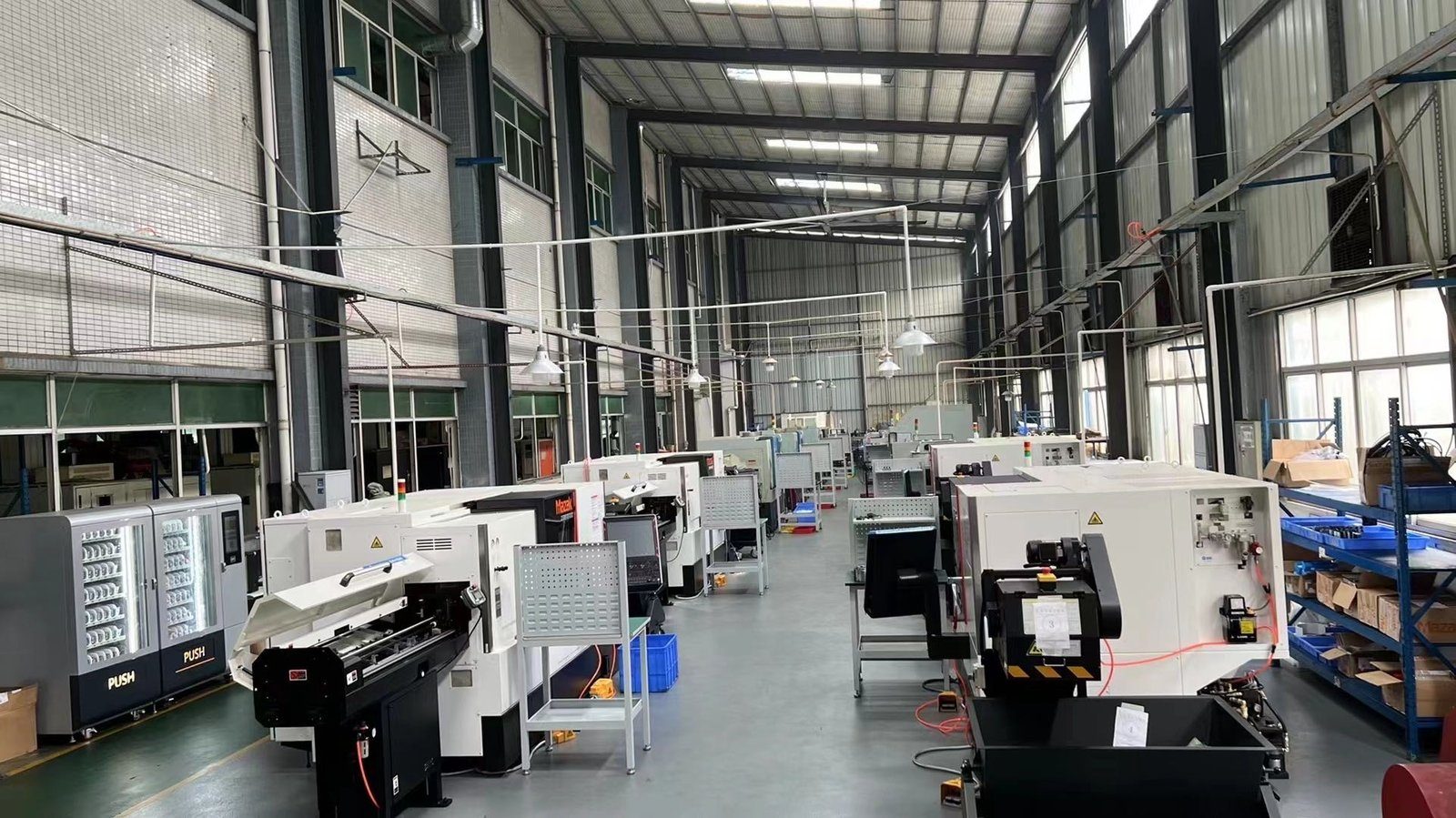
The metal-cutting core runs in one 6,800 m² facility, which keeps a multi-process part moving between operations at any batch size without a hand-off to another shop.
| Service | Capacity | Max workpiece |
|---|---|---|
| CNC milling (3-axis) | 50+ centers | 1300 × 700 × 600 mm |
| CNC milling (4-axis) | 20+ centers | |
| CNC milling (5-axis) | 20+ centers | |
| CNC turning | 25+ lathes | Ø720 × 1280 mm |
| Mill-turn | Multi-task centers | Single-setup complex geometry |
| Precision grinding | 7+ (surface / centerless / cylindrical) | ±0.002 mm finishes |
Why in-house matters beyond convenience: every hand-off to an outside shop adds freight, a queue, and a second inspection — each one a small cost that compounds across a multi-process part. When milling, turning, and grinding share one roof, a part moves between operations on the same schedule, and the cost stays on the curve you were quoted instead of drifting up with every border the part crosses.
How does single-setup machining lower unit cost?
Mill-turn and multi-task machines combine turning and milling in one clamping, which removes a setup event and a re-locating from the process. That is a fixed cost eliminated, and it amortizes across every part in the run. It also removes a source of locating error, so the part's geometry is more consistent, and consistency means fewer rejects, which is the hidden cost that erodes a volume discount.
Why single-setup matters more as volume climbs: a setup eliminated is a fixed cost removed, but a locating error eliminated is a reject rate removed, and rejects scale with quantity. On a long run, the locating accuracy of a single clamping is worth more than the setup time it saves, because a small error repeated on a thousand parts becomes a large rework bill.
your signal is the part's feature count: if a part needs both turned and milled features that reference each other tightly, single-setup machining is the difference between holding the relationship and hoping for it. Ask whether the part can run in one clamping; the answer tells you how much of the price is process and how much is risk.
How does surface finishing affect batch cost?
Surface finishing — anodizing, plating, powder coating — adds a step with its own setup and inspection, so it raises the unit cost at every volume and pushes the part into the longer lead-time tier. In-house ovens reach 500 °C for aluminum and low-temperature steel stress relief; titanium stress relief above that runs through a qualified partner. The step is named on the quote, so its cost and its schedule impact are visible rather than buried.
Why finishing is a multiplier, not an add-on: it does not just add one step — it adds a setup, an inspection, a queue, and a re-handling, and it can expose a defect that then has to be reworked. On a low-volume part the finishing step can be a large share of the total; on a high-volume part it compounds across every piece. Either way, it deserves its own line on the quote, and if you let it stay buried, you are paying for a step you cannot see.
What workpiece sizes can you machine?
Milling handles workpieces up to 1300 × 700 × 600 mm, and turning up to Ø720 × 1280 mm. The envelope matters for economics too: a part that fits runs in one setup, while a part that does not fit gets flagged before quoting, so you are not quoted a price for a process that would need re-work or re-fixturing.
Why the envelope is a cost boundary: a part that fits the machine runs in one clamping; a part that nearly fits forces extra fixturing, re-locating, or a larger machine at a higher rate. The difference is not the material — it is the setup count and the risk of a locating error, both of which show up in the unit price and both of which a good shop flags before quoting rather than after.
your check is to state the envelope up front with the drawing. A shop that asks for the envelope before quoting is pricing the process it can actually run; a shop that quotes blind is pricing a hope.
Why does MOQ 1 piece matter for the economics?

An MOQ of 1 piece removes the artificial floor under a program, so you buy exactly the quantity you need at each phase. A single first article validates the design and the process before any volume is committed; then the production run rides the amortized unit cost. Low-volume work runs on the same machines and the same discipline as production, so the validation is meaningful and the scale-up happens without a re-qualification.
Why the floor matters across services: every service has a setup cost, and an MOQ forces you to amortize that setup over a minimum batch you may not need. On a multi-process part, the floor multiplies — you are buying a minimum of each step, not just one. An MOQ of one piece lets you validate each service on its own terms, at the quantity the phase actually calls for.
How do you quote a service across batch sizes?

Quote each service at your pilot quantity and your production volume, and ask for setup separated from unit price. The gap between the two unit prices is the amortization curve for that service. Then confirm the process steps, because a multi-process part carries several setups, and the step count is what the unit cost actually scales with.
Send a drawing and the shop will break out material, setup, and unit price at your stated quantities, so the economics of each service are visible, not hidden in a single number.
Before you accept a service quote, run it through these questions from your side of the table:
- Is setup shown separately for each service? A multi-process part carries several setups — count them.
- Which service is the bottleneck for this part? The slowest step sets the lead time and the cost floor.
- Can the part run in one clamping? Fewer clamps means fewer setups and fewer locating risks.
- Which finishes are in-house and which are outsourced? Each outsourced step adds a queue and a margin.
- Does the same cell run my prototype and my production? If not, the validation does not carry over.
Why does the process routing decide more than the machine?
The machine sets the ceiling; the routing sets the cost. Two shops with identical machines can quote the same part very differently because one planned a three-step routing and the other a six-step one. The routing — which operations, in what order, with how many setups — is where the unit cost is actually decided, before the spindle even turns.
your lever is to ask for the routing, not just the price. A shop that explains its routing is showing you where the cost lives; a shop that will not is asking you to buy the price without the logic behind it.
How does a multi-process part test the whole cost curve?
A multi-process part is the sharpest test of batch economics, because it carries several setups and several hand-offs, each of which amortizes at a different rate. Turned features may amortize quickly; a finish grind may amortize slowly; a plating may not amortize much at all. The part's unit cost is the sum of several curves, and reading them separately is how you find the one step that is holding the price up.
The buyer who breaks the part into its processes can then attack the right step — combine two setups, reorder a heat treatment, move a plating in-house — instead of negotiating the total blindly. Cost reduction, on a complex part, is done step by step.
Why does the reorder price matter more than the first-order price?
The first order carries every setup at once; the reorder carries none. The reorder price is therefore the number you will actually pay for most of the part's life, and it is the number you should optimize. A shop that wins the first order with a low pilot price but holds a high reorder price is not cheap — it is expensive where it counts.
How do you match a service to a batch size?
Each service has a natural batch where its economics are cleanest. Turning rewards volume on simple round parts; mill-turn earns its keep on complex parts where a single setup replaces two or three; grinding pays off when the tolerance is tight enough that nothing else will hold it. Matching the service to the batch is the difference between paying for capability you need and capability you do not.
Why does tolerance decide which service you are actually buying?
Tolerance is the hidden selector on every drawing: a loose tolerance is a milling job; a tight one is a grinding job. The buyer who reads the tolerance callouts knows which services the part actually needs before the first quote comes back, and can tell when a shop has quoted a cheaper process than the drawing will survive.
The check is to ask which service each tolerance drives. If a shop quotes milling on a feature that needs ±0.002 mm, the price looks good and the parts will not, and the rework is a cost the cheap quote quietly handed you.
How does a service quote hide or reveal the real economics?
A service quote reveals economics when it names the process, the setup, the material, and the quantity; it hides them when it folds everything into one number. The difference is the difference between a price you can reason about and a price you can only accept or reject. The buyer who asks for the breakdown is the one who can optimize; the one who accepts the single number is the one who will pay whatever the hidden line says.
Why do you quote at two quantities, not one?
A single quantity gives you a point; two quantities give you a line. The line — the slope between your pilot price and your production price — is the amortization curve, and it is the only part of the quote that tells you whether this part rewards scale. If you quote one quantity, you are buying a price; if you quote two, you are buying economics.
What does it mean that the MOQ is one piece for every service?
It means no service has a hidden minimum of its own. A single part can be turned, milled, mill-turned, and ground without tripping a floor on any one step. That is the difference between validating a design on the actual process and validating it on a stand-in, and it is why the first article here predicts the production run instead of just resembling it.
How do you confirm the economics before you release volume?
Before releasing volume, lock the four numbers that decide the curve: the setup for each service, the reorder unit price, the routing step count, and the lead time at your production quantity. With those four in hand, the volume decision is arithmetic; without them, it is a guess. The buyer who locks them in writing is the one whose scale-up lands on the curve it was planned on.
How does a single drawing become a single honest price?
A drawing becomes an honest price when the shop reads it the way you drew it — same grade, same steps, same tolerance, same envelope — and quotes exactly that. The path from drawing to price is where most of the risk in a quote lives, because every assumption the shop makes without asking is a number it chose for you. A shop that questions the drawing before quoting is doing you a service; a shop that quotes without a single question is telling you it did not actually read it.
What this shop actually runs
Capability evidence should come as specifics, not slogans. Behind this guide is a 6,800 m2 plant in Dongguan, China running 100+ CNC machines with 100+ staff. The machine list by category:
- 5-axis machining centres (10+) - Mazak VARIAXIS I-600 (510/910/510 mm travel, 12,000 rpm, 22 kW, 71.6 N·m, 30-tool BT40) and Mazak INTEGREX I-250H S (B-axis 0.0001°, 24 kW, 124 N·m, 38-tool HSK-A63). Built for compound-angle parts, single-setup multi-face prismatic work, and aerospace fittings where datum transfer loss is unacceptable.
- 3-axis / 4-axis machining centres (50+) - Brother SPEEDIO S500Z2N / S700Z2N (10,000 rpm, 14/21-tool ATC, 0.7 s tool-to-tool, Z-axis 2.2 G) and Mazak VCE-430A L / VCE-570C L (10,000 rpm, 118 N·m, 24-tool ATC). Built for prismatic parts, plates, brackets, housings.
- Swiss-type turning centres (10+) - Citizen Cincom A20-3F7 (Φ20 mm, 10,000 rpm), TSUGAMI B0206-III / B0205-III (Φ20 mm, 0.1 µm), STAR SR-32JII / SR-32J Type N (Φ32 mm, 8,000 rpm). Built for long, slender rotational parts at ±0.002 mm.
- CNC turning centres (20+) - HEADMAN T70M/1250 (720 mm swing, 117 mm bore, 3,000 rpm, BMT75 12-station turret). Built for shafts, bushings, flanges up to ±0.002 mm.
- Wire EDM (5+) - Sodick AQ535L (550/350/300 mm travel, ±20° taper, 800 kg workpiece). Built for hardened tool steel, internal splines, sharp internal corners that milling cannot reach.
- Inspection: Hexagon CMM + 20+ gauges - Hexagon CMM for coordinate measurement, plus vision system, profilometer, hardness tester, coating thickness gauge, XRF for material verification. The 10:1 rule (gauge 10x more accurate than the band) is applied to every feature.
- Machine highlights - VARIAXIS I-600: one-setup multi-face 5-axis + MAZA-CHECK auto-calibration; INTEGREX I-250H S: DONE-IN-ONE mill-turn, B-axis 0.0001° + Ai thermal shield; SPEEDIO S500Z2N / S700Z2N: Z-axis 2.2 G + 0.7 s ATC; Swiss-type: guide-bush switchable + 0.1 µm resolution.
Tolerance: ±0.003 mm CNC milling / ±0.002 mm CNC turning / ±0.002 mm grinding and wire EDM. Capability: Ppk >= 1.67 initial on key characteristics, Cpk >= 1.33 ongoing.
Certificates: ISO 9001:2015 (116024/A/0001/UK/En), IATF 16949:2016 (131941/A/0001/SM/En, with design clause 8.3 excluded, stated openly) and ISO 14001:2015 (116024/B/0001/UK/En), issued to Dongguan Zhuohang Ltd, registration 91441900MA4UWT6X39, founded 2005.
Where we ship: Austria, Belgium, the Czech Republic, Denmark, France, Germany, Greece, Hungary, Ireland, Italy, the Netherlands, Spain, Sweden and the United Kingdom in Europe; Brazil, Canada, Mexico and the United States in the Americas; China, Israel, Japan, Singapore and Sri Lanka in Asia; Australia and New Zealand in Oceania; and South Africa in Africa — plus other countries and regions worldwide, shipped from our base in Dongguan, China.
Contact: Felipe Iglesias, [email protected], +86 13126536955.
See the cost curve across these services.
Send your drawing to [email protected] or call +86 13126536955 for setup and unit price at your quantities.
Frequently Asked Questions
Can the same service handle a prototype and a production run?
In short, Yes. Milling, turning, mill-turn, and grinding serve both a single first article and a production run on the same machines and the same quality system.
How does setup cost work across services?
Each service carries its own setup — programming, tooling, fixturing — and that setup is a fixed cost divided across your run. A multi-process part carries the sum of several setups, which is why step count drives both cost and price.
Which services run in-house?
CNC milling (3, 4, and 5-axis), CNC turning, mill-turn, and precision grinding run in-house across 100+ production machines, so a part can move between processes at any batch size without a hand-off to another shop.
How does single-setup machining lower unit cost?
In short, Mill-turn and multi-task machines combine turning and milling in one clamping, removing a setup event and a re-locating from the process. Fewer setups means fewer fixed costs to amortize and fewer chances for a locating error, lowering both cost and risk.
Do you take single-part and low-volume work?
Yes. The MOQ is 1 piece, so a prototype or first article runs before any volume is committed. The single part is produced under the same control as the production run, which makes the validation meaningful.
How does surface finishing affect batch cost?
Surface finishing adds a step with its own setup and inspection, so it raises the unit cost at every volume and pushes the part into the longer lead-time tier. The step is named on the quote so its cost is visible.
Standards referenced on this page
- ASTM A582/A582M-12 — Standard Specification for Free-Machining Stainless Steel Bars
- ASTM B348/B348M-21 — Standard Specification for Titanium and Titanium Alloy Bars and Billets
- ISO 9001 — Quality management systems — Requirements