
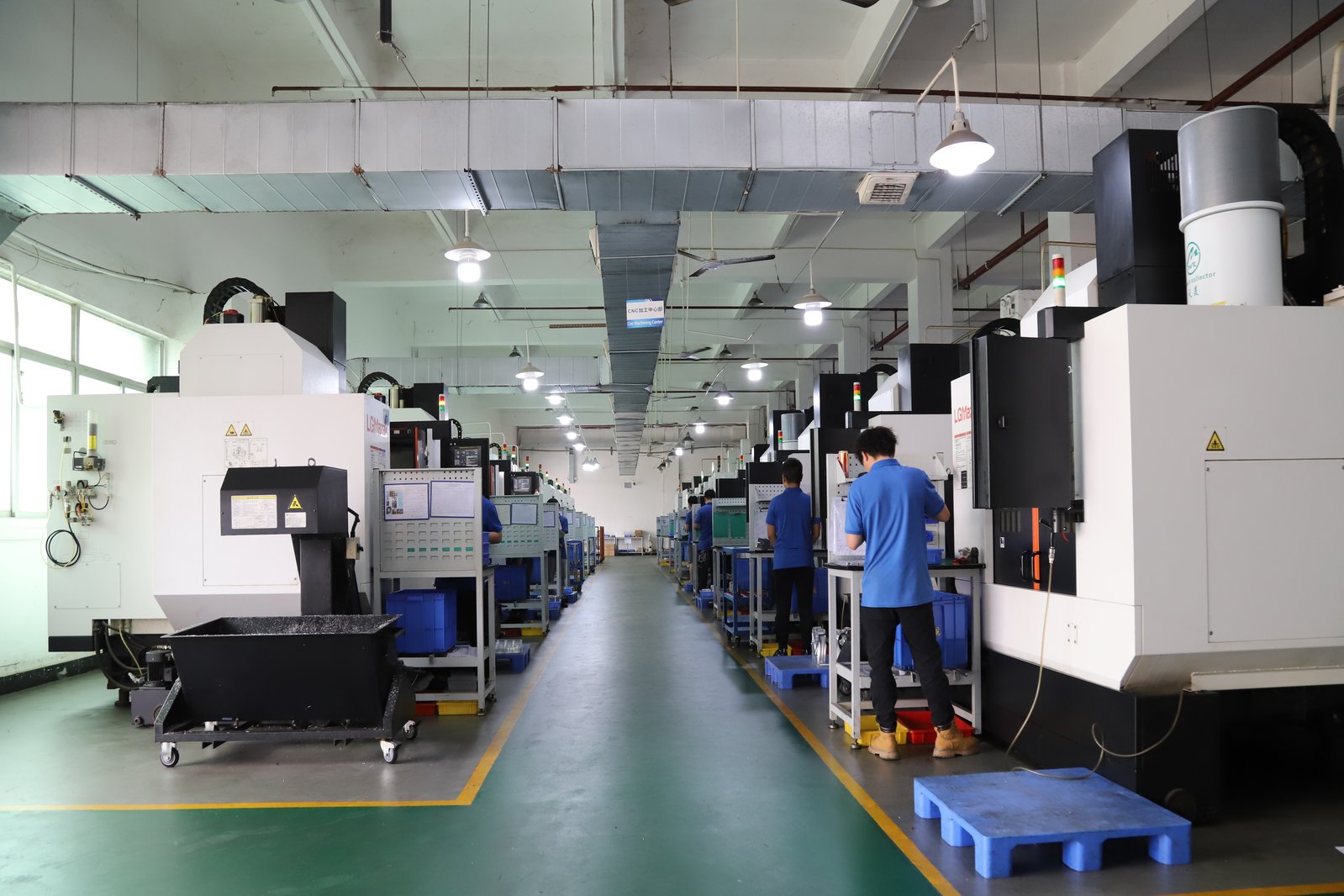
Round parts are the quiet majority of precision manufacturing. Fittings, shafts, sleeves, spindles, couplings, and valve bodies share one trait: their geometry is organized around a centerline, and that fact shapes the process decision more than any other. For most buyers the default is obvious — you turn a round part — but the alternatives are not always worse, and they are often cheaper at the right volume or the right geometry. This guide is a decision filter for cylindrical hardware: it explains when turning is genuinely the natural process, when mill-turn or swiss-type machining changes the answer, when casting, forging, extrusion, or cold heading should win the order, and how to compare the total cost across processes before you commit.
Why is turning the default for round parts, and when does that stop being true?
Turning earns its place as the default because the process matches the geometry. The workpiece rotates against a fixed tool, so roundness, concentricity, and cylindricity are produced by the machine's geometry rather than by a toolpath's interpretation of it. Material removal is efficient because the whole circumference moves past the cutting edge, and the bar itself can be loaded automatically, which is why turned parts quote well from one piece to high volume. For a shaft, a fitting, or a sleeve, starting anywhere but a lathe is usually starting from a disadvantage.
The default stops holding in three situations. When the part's dominant geometry is prismatic — a bracket with a round boss, a plate with one bore — the work belongs on a mill, and the round feature is milled with an interpolated or indexed tool rather than justifying a whole turning setup. When the geometry mixes turned and milled features that must stay concentric to each other, the answer is mill-turn, which holds the part once. And when volume or shape favors a near-net process — a head on a forged or cold-headed blank, a housing that exists because of a casting — turning retreats to the finishing role it plays so well. None of those are arguments against turning; they are arguments for matching the process to the part's actual axis story.
Turning, milling, or mill-turn: which machining route fits your part's geometry?
Divide the drawing by feature type and count which side wins. Diameters, bores, grooves, threads, and faces — axisymmetric features — are the lathe's home turf. Flats, slots, keyways, cross-holes, and pockets are milling features, reachable on a lathe only with live tooling. A part that is 90 percent axisymmetric with two cross-holes is a turning job with a drilling operation; a part that is a block with a threaded bore and four corner holes is a milling job with a threading operation. The split decides the machine, the setup count, and the datum story.
Mill-turn machines collapse the distinction. With live tooling and a C or Y axis, the machine turns the diameters and then mills the flats and cross-holes without releasing the part, so the concentricity between a turned journal and a milled keyway is set by one clamping instead of two. That single-setup logic is why mill-turn quotes win on parts where turned and milled features must agree on the axis. The cost of the flexibility is that a mill-turn cycle is usually slower than a dedicated process at very high volume, which is the trade to price when the quantity is in the tens of thousands.
Conventional turning, swiss-type, or mill-turn: which machine class fits the part?
Within the turning family, the machine class follows the part's slenderness and feature mix. A short, stiff part — a fitting, a pulley, a flange — runs on a conventional chucking or bar lathe, held firmly and machined fast. A long slender part, with a length-to-diameter ratio that would make it deflect under normal chucking, belongs on a swiss-type sliding-headstock machine, where the bar is supported right at the tool and the part never has to take the bending a conventional setup would impose. Parts with heavy off-axis milling content belong on a mill-turn center, where the features can be cut in the same clamping that produced the diameters.
The practical test is to ask the supplier which machine it would choose for your part and why. A shop that answers in terms of your diameter, length, and feature list is doing the engineering; one that quotes every round part on the same machine has one process and will force your part to fit it. The question also surfaces honesty about bar stock — long slender parts need straight, well-conditioned bar, and the bar diameter and straightness callout belong on the drawing alongside the part tolerance. When the machine class and the material condition are both right, the turning itself becomes routine.
Which materials belong on a lathe, and when does the material choose the process?
Turning works best on materials that cut predictably in bar form, and the free-machining grades exist for exactly that reason. The table below maps the common round-part materials to their behavior and their natural process route.
| Material | Typical turned parts | Turning behavior | Process note |
|---|---|---|---|
| 6061-T6 / -T651 aluminum | Fittings, adapters, housings, spacers | Fast, clean cutting; excellent thread quality | Bar-fed turning or mill-turn; -T651 for thin sections |
| Brass C360 / free-machining grades | Connectors, valve components, small fittings | Outstanding chip control and surface finish; very fast cycles | Screw machine or CNC turning at high volume |
| 1215 / 12L14 steel | Studs, shafts, non-critical hardware | Free-cutting; good for production turning runs | Cheap route for general hardware, not for high-load parts |
| 303 / 304L stainless | Fittings, instrument parts, corrosion-critical hardware | 303 machines easily; 304L tougher but cleans up well | Specify the right grade — they are not interchangeable |
| 17-4PH stainless | High-strength fittings, valve spools, aerospace hardware | Machines soft, ages to strength, then finish-turned | Heat-treat step belongs in the route, with a certificate |
| Ti-6Al-4V / Inconel 718 | High-performance aerospace and high-temperature parts | Slow speeds, heat at the edge, demanding on tools and setup | Price the cycle honestly; near-net forging or additive can cut material waste |
When the material exists only in a non-bar form — a casting alloy, a forged preform, a powder-metal grade — the process decision has already been made for you, and turning enters as the finishing step that produces the final diameters and threads. Conversely, a design that starts on paper as a casting often turns out to be a simple bar part in 6061 or C360 once the loads are checked. The material callout and the process choice are one decision, and the cheapest conversation you will have is the one that questions both at the same time.
When do casting, forging, extrusion, or cold heading beat turning on round parts?
Each near-net process wins in a specific corner. Casting produces shapes that cannot be machined from bar at all — a housing with internal passages, a part with complex exterior detail. Forging produces the grain flow and strength that a billet cannot, which is why high-load shafts and structural fittings specify forged material. Extrusion wins for long constant-section profiles that would waste most of a bar in the chip bin. Cold heading forms simple round heads and bodies in seconds at huge volumes, which is how fasteners and fittings are made by the million.
The decision rule is the same as everywhere in process selection: compare total cost at your real volume, with tooling amortized and secondary machining included. A cold-headed or forged blank almost always needs a turning pass to produce the finished threads, seats, and faces — the near-net process saves material, not the machining that makes the part fit. And each new tool carries a qualification risk and a revision cost that machined-from-bar does not. For a part whose design is still moving, bar-fed turning absorbs drawing changes as program edits; a new die absorbs them as money and weeks. That asymmetry is why so many round parts stay on the lathe until the design truly freezes.
Where does additive manufacturing win for round hardware, and where does it lose?
Additive manufacturing earns a place on round parts when the value is inside the shape. A manifold with internal cooling channels, a lightweight component where the material is removed to save weight, a titanium part where machining from bar would waste a fortune in chips — those are parts where printing produces the near-net form and turning finishes the datum diameters, the threads, and the sealing faces. At low volume with an expensive material, the additive-plus-turning route can beat machining from solid on total cost.
Additive loses on the properties that turning exists to provide. A printed surface carries layer steps, so it has no natural roundness or machined lay; printed tolerances cannot touch the band that turning holds; and the microstructure of a printed part is a different engineering question from bar stock. The pattern that works is hybrid: print the shape that machining cannot produce economically, leave stock on the features that must be round and precise, and turn those features to the drawing. Ask the machining shop whether it can run that finishing half of the job, and whether the near-net blank actually leaves enough stock for it.
How do tolerance and surface finish requirements filter turning against the alternatives?
Tolerance is the filter that ends most arguments quickly. Casting, forging, extrusion, and additive processes deliver near-net shapes measured in tenths of a millimetre; turning and milling hold fit and alignment features to ±0.003 mm, and precision grinding reaches ±0.002 mm, with capability of Cpk 1.67 or higher on key characteristics and Cpk ≥ 1.33 on general characteristics. Capability is reported per characteristic: every report names the feature, its tolerance band, the sample size, the sigma method, and the study window. When the drawing carries a tight journal, a sealing diameter, or a concentricity callout, the turning family is effectively the only route — the alternatives feed it a blank, and the lathe produces the final fit.
Surface finish filters the same way. A turned surface carries a characteristic machined lay and reaches Ra 1.6 µm or better on functional features with the right finishing pass, while ground surfaces go lower where seals and bearings demand it. Cast, forged, printed, and extruded surfaces carry their process texture and need machining to reach any finish the drawing takes seriously. Put the tolerance and finish callouts from your drawing next to each process's realistic output before requesting quotes, and you will avoid the classic mistake of quoting a near-net process that cannot hold the drawing's functional features.
How should you compare total cost across turning and the alternatives when sourcing from China?
Compare total cost at your real quantity, with every element visible. The quote structure should separate material, machining, tooling (when it exists), secondary operations, inspection, and freight — a supplier that buries tooling in the unit price is hiding the crossover point where a near-net process would win. Add the material story: turning from bar buys a block of certified material and cuts part of it into chips, while a forged or cast blank starts near the final shape, and for expensive alloys the difference can outweigh the machining cost entirely.
Then add the two costs that never appear on a quote: qualification and revision. A new die or mold has a first-article cycle and a revision cost that machined-from-bar does not, and your own inspection of a new process has a price. When the numbers are on the table, ask the supplier for an honest recommendation — a turning and milling shop worth keeping will tell you when a near-net process is the cheaper route, because that honesty is what keeps the rest of your work coming back. The services page explains how turning and milling programs are structured and quoted, and the batch-economics FAQ covers how setup, volume, and material drive the unit price you are comparing.
Frequently Asked Questions
When should a round part be turned instead of milled?
Turn it when the part is essentially axisymmetric — diameters, bores, grooves, and threads sharing a centerline. Turning produces roundness and concentricity naturally and removes material far faster than a mill sweeping around the part. Mill when the dominant geometry is prismatic, and choose mill-turn when the part mixes both.
What is mill-turn machining, and when does it beat separate turning and milling operations?
Mill-turn combines a lathe spindle with live tooling, so diameters, flats, slots, and cross-holes are cut without re-chucking. It wins when concentricity between turned and milled features matters. Separate operations make sense only for very large parts or volumes high enough to run processes in parallel.
Should a long slender part go to a swiss-type machine?
Yes, when the length-to-diameter ratio is high enough that the part would deflect under conventional chucking. Sliding-headstock machines support the bar at the tool, so long thin shafts hold tolerance where a standard lathe would push and chatter. Ask the shop which machine class your part actually needs.
Is cold heading or screw machining cheaper than turning for simple parts?
At very high volumes of a simple round shape, yes — the processes form parts in seconds and waste little material. But they need ductile grades, and the finished fits usually still require a turning or threading pass afterward. Below the volume where the high-speed process pays back, CNC turning is more flexible and often cheaper.
Which aluminum grade is best for turned parts from bar?
6061-T6 or -T651 is the standard for general parts; 2024 and 7075 are chosen when strength demands them, with 7075-T7351 for stress-relieved thin sections. Free-machining grades such as 2011 or 6262-T9 cut faster and lower unit cost on high-volume small parts.
What tolerance can turning realistically hold compared with other processes?
Turning and milling hold fit and alignment features to ±0.003 mm, and precision grinding reaches ±0.002 mm, with Cpk of 1.67 or higher on key characteristics and Cpk ≥ 1.33 on general characteristics. Capability is reported per characteristic: every report names the feature, its tolerance band, the sample size, the sigma method, and the study window. Casting, forging, extrusion, and additive deliver near-net shapes in tenths of a millimetre. Where the tight bands or concentricity rule, the turning family is the only route.
Can I print or forge a near-net round part and finish it by turning?
Yes, and it is the standard pattern for expensive materials and difficult geometry. The near-net process saves material; turning produces the datum diameters, threads, and sealing surfaces to the drawing. The hybrid works when the blank leaves enough stock and the datum strategy is planned across both processes.
Not sure whether your round part should be turned, mill-turned, swiss-machined, or formed near-net?
Email [email protected] or call +86 13126536955 for an honest process recommendation — including when turning is not the right answer.